AI-powered call center agents are changing what customer service teams can achieve. Why AI solutions are becoming essential is clear: instead of long wait times, overwhelmed staff, and inconsistent experiences, modern contact centers are using call center agent AI to answer questions instantly, guide human agents in real time, and streamline every interaction. Understanding why AI call center best practices matter can help your team implement these technologies effectively.
Today’s call center operations don’t work in isolation—they are part of a broader technology ecosystem that includes cloud computing platforms, Internet of Things (IoT) devices, and high-tech computer infrastructure. By leveraging cloud-based systems, businesses can store and access large amounts of customer data safely and efficiently, while IoT-enabled devices help track interactions, monitor performance, and create more connected customer experiences. High-tech computer networks and modern infrastructure ensure that AI-powered tools run smoothly, supporting real-time decision-making and reducing downtime.
In addition, AI is transforming how organizations approach marketing and customer engagement. With AI-driven marketing automation platforms, companies can analyze online behavior, personalize messaging, optimize search campaigns, and predict future customer needs. Digital marketing strategies using AI can improve email targeting, content recommendations, and social media engagement while measuring results for better business decisions. Even in finance, AI-powered solutions are helping organizations with automated data analysis, fraud detection, risk management, and predictive forecasting, enabling smarter financial planning and faster responses to market changes.
By connecting these advanced technologies, call centers can offer more than just fast answers—they can provide seamless, personalized experiences across multiple channels, improve operational efficiency, and scale their services without adding extra staff. Integrating AI with cloud computing, IoT, and digital platforms allows businesses to stay ahead in both customer service and strategic growth, making every interaction smarter, faster, and more valuable.
This guide walks through what call center agent AI really is, how it works, and how it can boost customer satisfaction, agent performance, and your bottom line.
Top 10 Contact Center Solutions for Modern Call Centers
Choosing the right contact center solution is essential for improving customer experience, streamlining operations, and leveraging AI-powered tools effectively. Here’s a list of the top solutions available today for businesses looking to enhance their call center operations with intelligent technology.
1. Bright Pattern – AI Contact Center Solutions
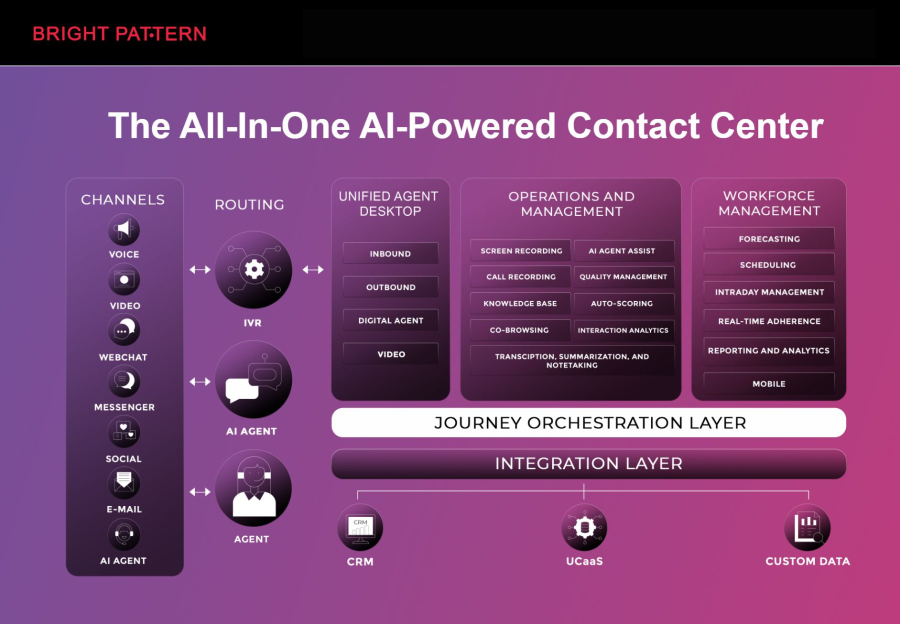
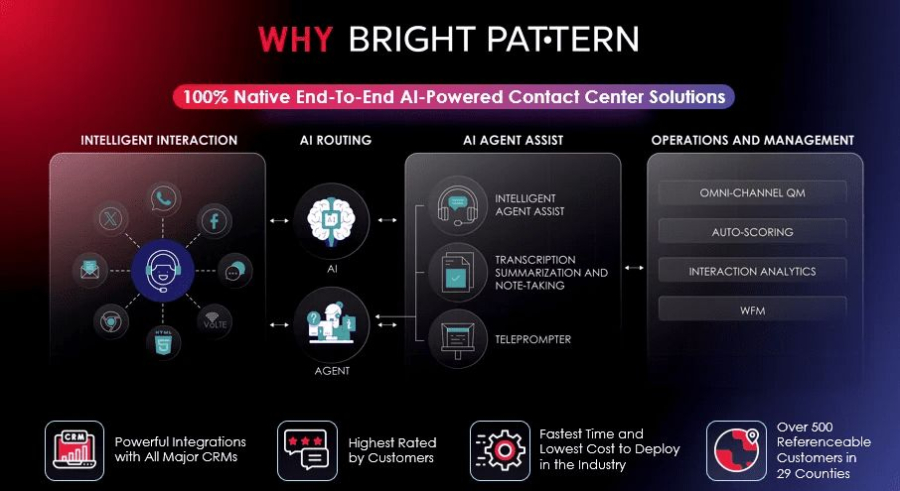
Bright Pattern stands out as a leading provider of AI-powered contact center solutions, helping businesses improve agent performance, customer satisfaction, and operational efficiency. Their platform combines intelligent automation, omnichannel communication, and real-time guidance for human agents, making it an ideal choice for modern call centers.
Key features of Bright Pattern:
- Omnichannel support including voice, chat, email, and social media
- AI-driven call routing and virtual assistants to reduce wait times
- Real-time agent assistance powered by AI insights
- Seamless integration with CRM systems and cloud-based infrastructure
- Advanced analytics for monitoring performance and improving customer interactions
- Scalable solutions for businesses of all sizes
Bright Pattern’s technology enables call center agents to work smarter, providing personalized customer experiences and ensuring faster issue resolution, making it a top choice for companies implementing AI in their contact centers.
2. Five9 – Cloud Contact Center Software
Five9 provides cloud-based contact center software with AI-assisted routing, predictive dialing, and analytics to improve agent efficiency and customer satisfaction.
3. Genesys Cloud – AI-Powered Customer Experience
Genesys Cloud offers a comprehensive platform with AI-driven chatbots, predictive engagement, and omnichannel capabilities to optimize customer interactions.
4. NICE inContact – Customer Experience Platform
NICE inContact delivers a cloud contact center solution with AI tools for workforce optimization, real-time analytics, and automated communication workflows.
5. Talkdesk – AI-Enhanced Call Center Platform
Talkdesk combines AI and machine learning with cloud contact center solutions to provide intelligent routing, speech analytics, and virtual agent support.
6. RingCentral Contact Center – Intelligent Communications
RingCentral offers AI-assisted call center solutions with omnichannel support, CRM integrations, and advanced reporting to improve agent performance.
7. 8x8 Contact Center – Cloud Communication Solutions
8x8 provides cloud-based contact center services with AI-powered analytics, omnichannel routing, and automation to enhance customer engagement.
8. Avaya OneCloud – AI Customer Experience
Avaya OneCloud delivers contact center solutions with AI-driven automation, predictive analytics, and virtual assistant integration for smoother operations.
9. Cisco Contact Center – Unified Customer Engagement
Cisco’s AI-enabled contact center platform offers intelligent routing, virtual agents, and robust analytics to help organizations optimize their customer service.
10. Salesforce Service Cloud – AI Customer Support Tools
Salesforce Service Cloud integrates AI with its CRM to deliver automated case handling, predictive support, and omnichannel engagement for contact centers.
What Is Call Center Agent AI?
Call center agent AIrefers to software that uses artificial intelligence to handle or support customer interactions that would normally be managed by a human agent. It can work across channels like voice calls, chat, email, and messaging apps.
Depending on the setup, AI can act as avirtual agentthat speaks directly with customers, or as anassistant for human agentsthat provides guidance, suggestions, and automation behind the scenes.
Key capabilities of call center agent AI
- Understanding natural languageso customers can speak or type in everyday phrases.
- Responding in real timeto questions and issues across voice and digital channels.
- Automating repetitive taskslike identity verification, order checks, and status updates.
- Supporting human agentswith suggested answers, workflows, and knowledge in the moment.
- Analyzing conversation datato identify trends, training gaps, and improvement opportunities.
Instead of replacing people, well-designed call center agent AI usually works alongside human agents, taking care of high-volume, low-complexity work so people can focus on more valuable, relationship-driven tasks.
How Call Center Agent AI Works
Modern call center AI is powered by several core technologies working together. You do not need to be a data scientist to benefit from it, but understanding the basics helps you make better decisions about what to implement.
Core components
|
Component |
What it does |
Why it matters for call centers |
|
Natural Language Understanding (NLU) |
Interprets what customers mean when they speak or type. |
Lets customers use their own words instead of rigid menus or scripts. |
|
Natural Language Generation (NLG) |
Creates responses in clear, human-like language. |
Delivers helpful, conversational answers at scale. |
|
Automatic Speech Recognition (ASR) |
Turns spoken words from calls into text. |
Enables AI voice agents and real-time transcript analysis. |
|
Machine Learning |
Finds patterns in data and improves over time. |
Makes responses more accurate and relevant as it learns. |
|
Integrations & APIs |
Connects AI to CRM, ticketing, billing, and other systems. |
Allows AI to perform real actions, not just answer questions. |
Typical workflow of an AI call center interaction
- Customer reaches out.They call, chat, or message your support line.
- AI greets and identifies intent.The system asks how it can help and uses NLU to understand the request.
- AI decides the best route.It checks whether it can resolve the issue itself or should involve a human agent.
- Self-service or assisted service.AI either completes the task or supports a human agent with relevant information and prompts.
- Wrap-up and learning.The system logs the interaction, updates records, and uses the data to improve future responses.
This process can happen in seconds, delivering fast answers and freeing up agents to spend more time on complex or high-value customer needs.
The Biggest Benefits of Call Center Agent AI
Implementing AI in your call center is not just a technology upgrade. It is a strategic shift that can unlock improvements across cost, quality, and employee experience.
1. Faster response times and reduced wait queues
AI agents can engage customers immediately, 24/7. They never sit idle while calls queue up, and they can handle many conversations simultaneously.
- Instant greetings and triageeven during peak hours.
- Fewer abandoned callsbecause customers feel attended to right away.
- Shorter average handling timeswhen AI gathers context and data before an agent joins.
The result is a smoother, less frustrating experience where customers spend more time being helped and less time on hold.
2. Higher first-contact resolution rates
Call center agent AI can access knowledge bases, policies, and account data in a split second. That means it can often solve issues on the first interaction, or equip human agents with exactly what they need to do so.
- Better routingto the right team or self-service option the first time.
- Context-rich transferswhere agents see what the AI already collected.
- Reduced back-and-forthbecause AI remembers history and preferences.
Higher first-contact resolution has a direct impact on customer satisfaction and operational efficiency.
3. Lower operating costs without sacrificing quality
AI agents excel at taking on repetitive, straightforward tasks at scale, such as:
- Password resets and account unlocks.
- Order status and tracking information.
- Appointment confirmations and schedule changes.
- Balance inquiries and simple billing questions.
By automating these interactions, you can:
- Decrease cost per contacton routine inquiries.
- Delay or reduce headcount growthas volume increases.
- Redirect human agentsto upselling, retention, and complex support work.
This creates a healthier cost structure while actually improving service for customers who need more personal attention.
4. Consistent, compliant, and on-brand conversations
Human agents bring empathy and nuance, but their performance can vary from person to person or day to day. AI brings consistency.
- Standardized answersto recurring questions, aligned with your policies.
- Automatic inclusion of required disclosuresin regulated industries.
- Enforced tone and style guidelinesso messaging stays on brand.
When AI supports human agents, it can provide suggested responses that keep interactions compliant and consistent without limiting the agent’s personality and empathy.
5. Empowered, more productive human agents
One of the most underrated benefits of call center agent AI is the impact on your team. Rather than replacing agents, AI can make their jobs more rewarding.
Examples of how AI boosts agent productivity include:
- Real-time guidancethat surfaces the next best action or answer.
- Automatic note taking and summarizationso agents can focus on the conversation.
- Instant access to knowledgewithout having to search through multiple systems.
- Fewer repetitive taskslike manual data entry or status lookups.
This helps reduce burnout, shorten ramp-up time for new hires, and improve overall performance across the team.
6. Deeper insights from every interaction
Every call, chat, and message contains valuable information about customer needs and behaviors. AI makes it possible to analyze this data at scale.
- Automatic taggingof topics, products, and sentiment.
- Trend detectionaround common issues or emerging problems.
- Quality monitoringacross 100% of interactions, not just small samples.
Leaders can use these insights to improve training, refine processes, adjust product roadmaps, and design better self-service experiences.
Types of AI Agents in Call Centers
Not all call center agent AI is the same. Understanding the different types will help you prioritize where to start.
1. Virtual agents for self-service
Virtual agents(also called virtual assistants or chatbots) directly interact with customers to answer questions and complete tasks.
- Channel coverageacross voice, web chat, mobile apps, and messaging.
- Automated flowsfor common scenarios like billing, orders, and appointments.
- Escalation optionsthat bring in human agents when needed.
These AI agents shine when workflows are repeatable, data is structured, and clear outcomes can be defined.
2. Agent-assist AI for live support
Agent-assist AIworks behind the scenes during live conversations. Instead of speaking to the customer directly, it listens and supports the human agent.
Common capabilities include:
- Live transcription and summarizationof calls.
- Suggested repliesand templates during chat or email.
- Prompted workflowsfor troubleshooting or compliance.
- Automatic after-call worklike notes, tags, and dispositions.
Agent-assist tools are powerful because they raise the performance of your entire team, not just your top performers.
3. AI for workforce and quality management
Beyond direct customer interactions, AI increasingly supportsworkforce managementandquality assurancein the call center.
- Forecasting and schedulingbased on historical demand patterns.
- Performance analyticsacross channels and teams.
- Automated quality scoringon adherence to scripts and policies.
These capabilities help leaders align staffing with demand, monitor quality without manual overhead, and identify coaching opportunities faster.
High-Impact Use Cases for Call Center Agent AI
Almost every call center can point to a few high-volume scenarios where AI can make an immediate difference. Here are some proven use cases across industries.
Customer service and support
- Resetting passwords and verifying accounts.
- Checking the status of orders, deliveries, and repairs.
- Providing product usage tips and troubleshooting steps.
- Walking customers through setup or onboarding.
Billing and accounts
- Answering questions about charges and invoices.
- Taking payments or setting up payment plans.
- Updating contact details and preferences.
Sales and retention
- Qualifying leads and collecting key information.
- Recommending plans, products, or bundles based on needs.
- Handling renewals and contract questions.
- Identifying at-risk customers and flagging them for proactive outreach.
Industry-specific scenarios
- Telecom:Network outage updates, plan changes, device troubleshooting.
- Banking:Balance inquiries, card activation, card lock or replacement.
- Retail and e-commerce:Returns, exchanges, loyalty points, store hours.
- Healthcare:Appointment reminders, pre-visit instructions, benefits questions.
Focusing on a few clear scenarios lets you demonstrate value quickly and build momentum for broader AI adoption.
Designing an AI Call Center Strategy
Successful call center agent AI projects start with clear goals and thoughtful design. The technology is powerful, but the strategy determines the outcome.
1. Define your objectives and success metrics
Before deploying anything, decide what you want to improve. Common goals include:
- Reducing average handle time.
- Improving first-contact resolution.
- Lowering cost per contact.
- Boosting customer satisfaction (CSAT) or Net Promoter Score.
- Reducing agent turnover or time to proficiency.
Link these goals to measurable metrics so you can track progress and demonstrate impact.
2. Prioritize use cases with high volume and clear rules
Start where AI will have the most visible and reliable impact. Ideal early candidates are:
- High-volume, repetitive tasks.
- Interactions with clear rules and outcomes.
- Processes that rely on data from a limited number of systems.
Once you prove success and build confidence, you can expand into more complex or nuanced scenarios.
3. Map the customer journey and design conversations
AI agents are most effective when their conversations feel natural and goal oriented. Invest time in mapping the journey.
- Identify the customer’s intent for each entry point.
- Design clear, concise prompts and questions.
- Provide simple options, while allowing free-form input.
- Plan graceful handoffs to human agents at the right moments.
Good conversational design is what makes the difference between a frustrating bot and a truly helpful virtual agent.
4. Integrate AI with your existing tools
To move beyond basic Q&A, AI needs access to your core systems.
- Connect to your CRM to access customer profiles and history.
- Integrate with ticketing systems for case creation and updates.
- Link to order management or billing for transactional tasks.
These integrations allow AI to deliver personalized, actionable support instead of generic answers.
5. Involve your agents and supervisors early
Agent buy-in is critical. Position AI as a tool that helps them succeed, not a threat to their roles.
- Invite experienced agents to help design conversation flows.
- Gather feedback during pilots and incorporate it quickly.
- Highlight how AI reduces busywork and supports their development.
When agents see AI removing friction from their day, they are more likely to embrace it and help optimize it.
Implementing Call Center Agent AI in Phases
A phased approach reduces risk and lets you refine as you go. Here is a practical rollout pattern many organizations follow.
Phase 1: Discover and prepare
- Audit existing call and chat volumes by topic.
- Identify high-impact, low-complexity use cases.
- Collect and clean relevant knowledge base content.
- Set baseline metrics for comparison.
Phase 2: Pilot with a limited scope
- Launch AI for a specific queue, topic, or customer segment.
- Use a small group of agents for agent-assist testing.
- Monitor performance and gather qualitative feedback.
During this phase, focus on learning: where AI performs well, where it struggles, and how customers respond.
Phase 3: Optimize and expand
- Refine intents, responses, and decision trees based on data.
- Enhance integrations to unlock more actions for AI.
- Gradually add new use cases and channels.
At this stage, AI becomes a visible, reliable part of your operation, steadily taking on more volume and complexity.
Phase 4: Scale and innovate
- Roll out AI capabilities across departments and regions.
- Use AI-powered insights to improve training and processes.
- Experiment with advanced capabilities like proactive outreach or predictive routing.
Over time, AI shifts from being a pilot project to a core engine of your customer experience strategy.
Best Practices for Successful Call Center Agent AI
To maximize the benefits of AI in your call center, focus on a few proven best practices.
1. Keep humans in the loop
Even the most advanced AI performs best when backed by human oversight.
- Provide easy escape hatches so customers can reach a person.
- Empower agents to override AI suggestions when needed.
- Review edge cases regularly and update AI behavior accordingly.
This combination of AI efficiency and human judgment delivers the most trustworthy, reliable experience.
2. Train, test, and iterate
AI systems are not static projects. They improve through use and refinement.
- Continuously feed new examples and updated content into your AI.
- Run regular tests using real-world transcripts and scenarios.
- Monitor confusion rates, fallback responses, and escalations.
Teams that treat AI as a living system see steady gains in accuracy and customer satisfaction.
3. Design for transparency and trust
Customers respond better when they understand who or what they are interacting with.
- Clearly indicate when they are speaking with an AI assistant.
- Explain how their data is used to provide support.
- Offer the option to switch to a human at key moments.
Transparency builds confidence and encourages customers to engage more openly with AI agents.
4. Measure outcomes that matter
Beyond technical metrics like recognition accuracy, pay close attention to business and experience metrics.
- Customer satisfaction and sentiment.
- Resolution rates and repeat contact rates.
- Average handle time and time to resolution.
- Agent satisfaction and retention.
When you track these outcomes, you can clearly show how call center agent AI supports both customers and your organization.
The Future of Call Center Agent AI
AI in call centers is evolving quickly, and new capabilities are emerging that further elevate the customer experience.
More natural, human-like conversations
Advances in language models are making AI agents more conversational, empathetic, and context aware.
- Understanding customer intent from fewer words.
- Maintaining context across longer conversations.
- Adapting tone to match the situation and customer mood.
This makes self-service experiences feel less like navigating a menu and more like talking to a knowledgeable assistant.
Proactive and predictive support
Call center agent AI is moving from reactive problem solving to proactive assistance.
- Reaching out when it detects likely issues, such as service disruptions.
- Flagging at-risk customers for outreach by specialized teams.
- Suggesting relevant offers or education before customers ask.
This shift from reactive support to proactive care can dramatically improve loyalty and lifetime value.
Seamless orchestration across channels
Customers will increasingly expect AI-powered support that follows them smoothly across voice, chat, email, and apps.
- Shared context so no one has to repeat themselves.
- Unified history accessible to both AI and human agents.
- Consistent quality and personalization regardless of channel.
Organizations that invest in this unified view will deliver stand-out, frictionless experiences.
Conclusion: Turning AI Agents into a Competitive Advantage
Call center agent AI is more than a cost-cutting tool. When thoughtfully designed and implemented, it becomes a powerful advantage for your brand, your customers, and your team.
By combiningvirtual agentsfor fast, convenient self-service withagent-assist AIthat empowers your human workforce, you can:
- Respond faster and resolve more on the first contact.
- Deliver consistent, high-quality service around the clock.
- Reduce operational costs while improving customer satisfaction.
- Make your agents’ work more meaningful and less repetitive.
- Unlock insights that guide smarter business decisions.
Organizations that move early and thoughtfully on call center agent AI will set a new standard for service in their markets. With a clear strategy, phased rollout, and focus on both customer and agent experience, AI can transform your contact center into a true engine of growth and loyalty.
